|
Opportunities for Landowners |
[
]
|
In the 1990’s a national coalition of nearly 3,000 organizations including hunting, angling, and conservation groups formed to advocate increased federal funding for the conservation or rare wildlife and their habitats. This continuing effort is known as Teaming with Wildlife. In response, Congress established the State Wildlife Grants Program.
To ensure efficient use of State Wildlife Grants, Congress required each state to develop a comprehensive wildlife conservation strategy for conserving biodiversity. Initiated in 2003 and approved in August 2005, the
Nebraska Natural Legacy Project was a grassroots effort lead by the Nebraska Game and Parks Commission and developed with the assistance of a variety of partners that included farm, ranch, and sportsmen groups, conservation agencies (including Rocky Mountain Bird Observatory) and the public.
The Legacy Project, or Plan, attempts to conserve Nebraska’s full array of biodiversity by reversing the decline of rare species and ensuring that common species stay common. Nebraska went the extra mile in their state plan by including strategies for increasing environmental education and nature-based recreation in the state. The Plan recognized that knowledgeable citizens are better stewards of the land and make wise, long-term political decisions regarding conservation. Encouraging Nebraskans to participate in hunting, fishing, hiking, bird watching and other nature-related activities will build appreciation for nature and provide economic diversification.
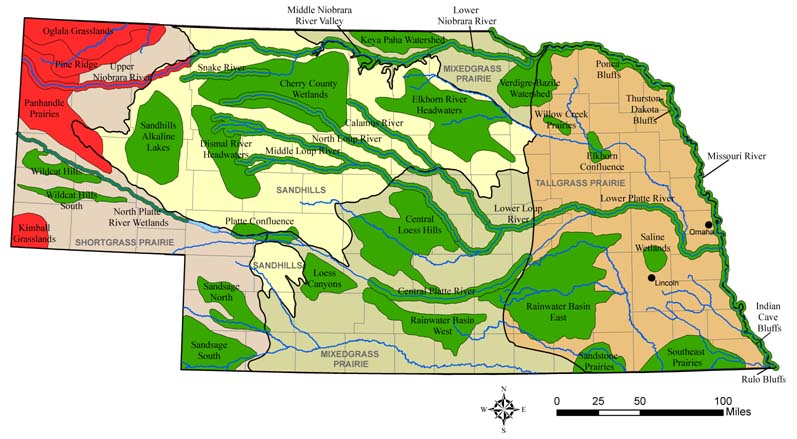
The Legacy Plan identified 40 Biologically Unique Landscapes (BUL’s) – areas with intact native plant communities, waterways or concentrations of rare species – on which to focus statewide conservation efforts. If you live in or near the Nebraska Panhandle, you also live in or very near one of several biologically unique landscapes (shown below). Conservation of these unique landscapes is expected to conserve the vast majority of wildlife species in the state.
|
|
In response to the Legacy Plan and the identification of several BUL’s in the
Nebraska Panhandle, Rocky Mountain Bird Observatory (RMBO) and the Nebraska Game
and Parks Commission joined forces to form the Nebraska Prairie Partners
(NPP). NPP has staff across the panhandle which delivers on all aspects of
RMBO’s mission from Research and Monitoring to
Environmental Education and
Outreach to on the ground Stewardship of resources. The Coordinating Wildlife
Biologist is available to assist landowners with habitat development on
private lands. Projects are designed to benefit wildlife, particularly species
of conservation concern, while maintaining a profitable farming or ranching
lifestyle. Prairie habitat conservation and enhancement on public and private
lands is vital for the long-term conservation of the shortgrass ecological
community.
Historically, Nebraska’s native vegetation was principally prairie. The Nebraska
Panhandle, with an annual precipitation of around 12 inches, was home to mixed
and shortgrass prairie. Dominant plants in the prairies included
needle-and-thread, blue grama, buffalo grass, blackroot sedge, and numerous wind
flowers. Wildlife was abundant, including large grazers, such as bison and
pronghorn and smaller animals such as swift fox and sharp-tailed grouse.
Agricultural development and other land-use changes have dramatically altered
Nebraska’s native landscape. While we are lucky in the Panhandle to still have
large, intact examples of native prairie, over 50% of the shortgrass/mixedgrass
prairie mosaic has been altered. Overgrazing, reckless use of herbicides, fire
suppression and/or invasive species have impacted much of the region’s remaining
prairies.
Currently, NPP and partner organizations are implementing strategies within the
Legacy Plan by working with landowners within five main BUL’s including the
Oglala Grasslands, Pine Ridge, Upper Niobrara River, Panhandle Prairies and
Kimball Grasslands on a wide array of projects. NPP will work with interested
landowners to apply on-the-ground habitat improvements. Projects may include,
but are not limited to, fencing to exclude livestock from wetlands or other
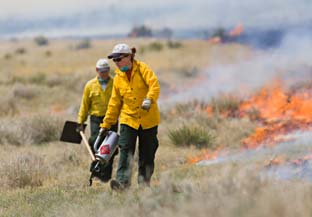
areas of interest, prescribed burning to reduce invasive species such as Eastern
red cedar and increase plant species diversity, thinning unnaturally thick
stands of ponderosa pine, and developing water sources for both cattle and
wildlife.
|
Since 2001, Nebraska has been awarded well over $5 million in State Wildlife
Grants for the betterment of wildlife habitat. Besides State Wildlife Grants,
funding for Legacy Plan projects comes from such funding partners as the
Landowner Incentives Program and Nebraska Environmental Trust, as well as from a
number of local and national conservation organizations such as Pheasants
Forever, Playa Lakes Joint Venture, National Wild Turkey Federation, and many
others. Up to 75% cost share is available for project costs and is often
accompanied by a 10 year contract developed with the management and goals of the
individual landowner in mind. With this effort, RMBO and its partners
hopes to improve the long-term viability of native habitats and increase public
awareness to the importance of conserving and maintaining habitats to keep
common species common and help reverse the plight of threatened and endangered
species.
|
 |
If you are interested in or have question about the Nebraska Prairie Partners or
would like to enroll in or receive more information about available programs
please contact:
Andrew E. Pierson
Coordinating Wildlife Biologist
Nebraska Prairie Partners
P.O. Box 489, 100547 Airport Rd.
Scottsbluff, NE 69363
ph: 308-220-0052
fax: 308-220-0053
email: andrew.pierson@nebraska.org
|
Additional Links:
Sharing Your Land with Prairie Wildlife
Stewardship Resource Guide for Private Lands in Western Nebraska
Wildlife Escape Ladders (for livestock watering tanks)
Aspens |
|
|
|