Contact us - Site Map - Webmaster - Staff Login
RMBO Home Page RMBO Blog RMBO Blog RMBO Blog Join RMBO on Facebook
Skip Navigation Links
About UsExpand About Us
Get InvolvedExpand Get Involved
PublicationsExpand Publications
News and EventsExpand News and Events
ScienceExpand Science
EducationExpand Education
StewardshipExpand Stewardship
InternationalExpand International
DatabaseExpand Database
   Skip Navigation LinksHome : Science : Special Species : Black Swift
Black Swift [ ]
     
In the summer breeding season, Black Swifts have a large distribution throughout North America. They can be found south to Central America, east to central Colorado, north to southeastern Alaska, and also in the West Indies. Despite this large range, prior to 2002 there were only about 80 known breeding sites for the species. Black Swifts typically breed near waterfalls or sea cliffs. Black Swifts are listed as a Species of Greatest Conservation Need in Colorado Division of Wildlife’s Wildlife Action Plan and a Sensitive Species by the Region 2 U.S. Forest Service.

At the end of the 19th Century, Black Swift was considered a locally abundant summer resident in Colorado, but breeding was not confirmed until 1949 when Owen A. Knorr found nests at Niagara Gulch and Cataract Gulch, both near Silverton. From 1949 through 1958, Knorr located approximately 80 nests at 27 sites in 10 counties in Colorado. His work extended the known geographical distribution of Black Swift breeding in Colorado north to the Front Range and the White River Plateau and east to the eastern flanks of the Sangre de Cristo Mountains (Knorr 1961). After Knorr’s work, only six more colonies were discovered by others in the next 50 years.

In 1998, Rich Levad of Rocky Mountain Bird Observatory (RMBO) joined forces with U.S. Forest Service biologists to inventory Colorado’s Black Swifts, beginning a database that catalogues known and potential nest sites. The database now contains over 400 entries—waterfalls, caves, and other potential Black Swift nesting sites; we have conducted at least a preliminary evaluation of 369 sites. We have documented 100 sites that have been occupied by Black Swifts in at least one year, including the 27 colonies located by Knorr in the 1950s. We have found 25 of Knorr’s 27 colonies, and we have documented continued occupancy at 23; we have not yet conducted adequate surveys at two. We have also surveyed the colonies that were located between Knorr’s work and ours; these, too, have all been occupied. Our surveys since 1998 have documented an additional 69 occupied sites.


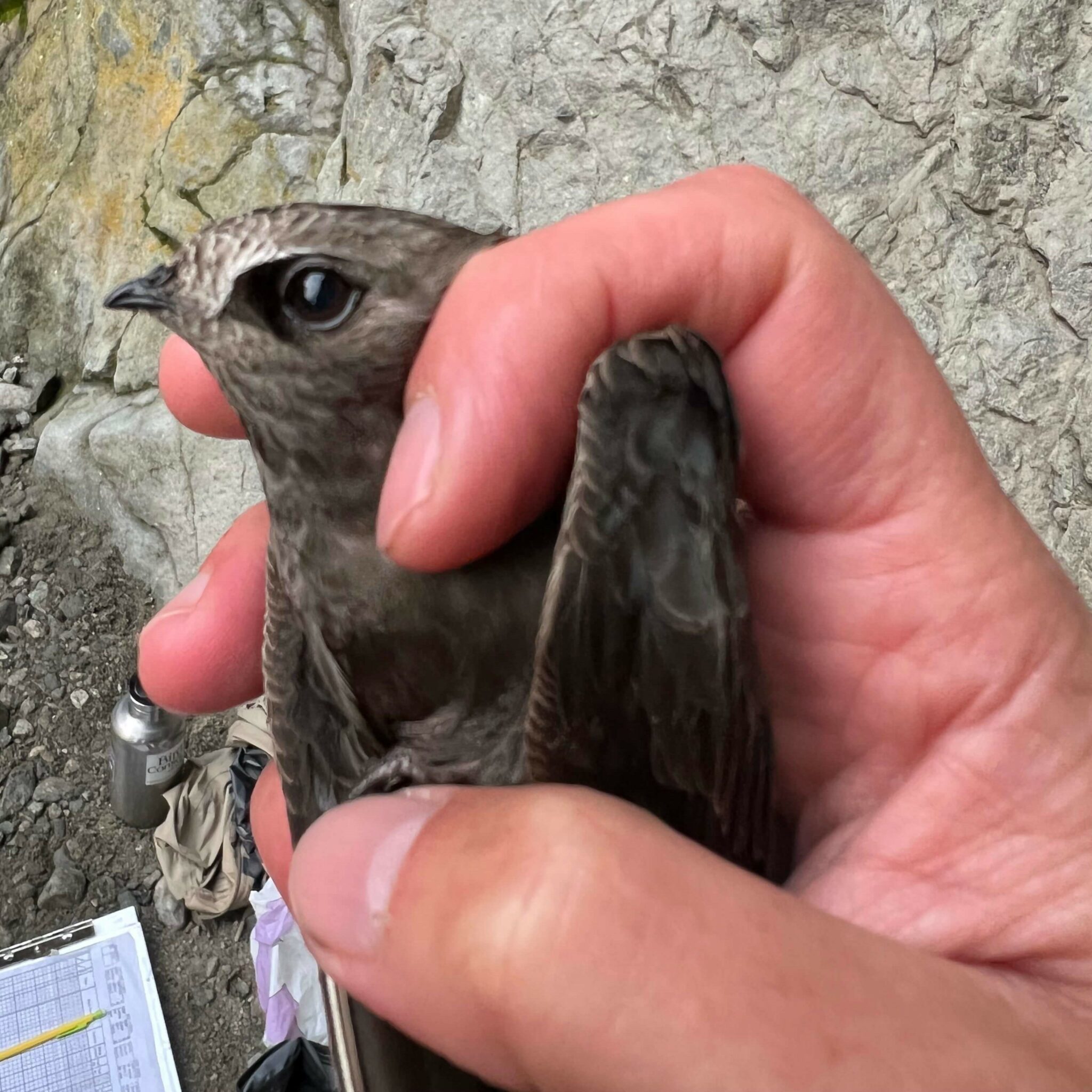
This photo taken by Tony Luekering at Zapata Falls
Rich also managed to conduct research on Black Swifts while searching for them throughout Colorado and New Mexico. In 2007 and 2008 Rich co-authored two publications which appeared in the Wilson Journal of Ornithology. The first publication presents Sue Hirshman’s detailed study of eleven years of Black Swift breeding phenology and success at Box Canyon in Ouray, Colorado. The second publication makes public the surveys conducted by RMBO and cooperators regarding distribution, abundance, and nest-site characteristics of Black Swifts in the southern Rocky Mountain region. These publications are available on our website for those interested.

Recently RMBO has continued researching Black Swifts by banding them at the few known colonies where this can be accomplished. While Owen Knorr was discovering new Black Swift breeding sites, which he often did using ropes to rappel into the nesting sites, he would band swifts if possible. He was even able to band adult swifts at night while dangling on a rope (yes, he may have been a bit crazy!) by blinding them with his headlamp before grabbing them. In 1998, RMBO and U.S. Forest Service biologists began banding nestlings at breeding sites where nests were accessible using ladders or ropes. We also discovered that it was possible at two of the known breeding colonies to place mist-nets across the narrow opening to the nest sites and capture adult Black Swifts as they return in the evening. The location where this was first attempted in Colorado – Zapata Falls in Alamosa County – has been revisited every August since 2004 and we have captured, or recaptured, at least five adult Black Swifts every year. In 2006, Kim Potter of the White River National Forest began banding adult Black Swifts using this technique at Fulton Resurgence Cave in the Flat Top Mountains. In the summer of 2008 at Fulton Resurgence Cave researchers recaptured a Black Swift that was banded at the same location as a nestling in 2005. This is the first time in Colorado that it has been documented that an adult swift would return to the same breeding colony where it hatched and attempt to breed. In total, over 100 Black Swifts have now been banded in Colorado. The Black Swift banding project is allowing RMBO researchers to answer questions about Black Swift longevity and site fidelity that is only possible by marking birds. This project will undoubtedly continue to yield more important and exciting information about this difficult to study species in the years to come.

For more information contact:
Jason Beason
Special Monitoring Projects Coordinator
jason.beason@rmbo.org or (970) 527-4625
Feedback