
|
|
|
|
Mountain Plover shading its eggs
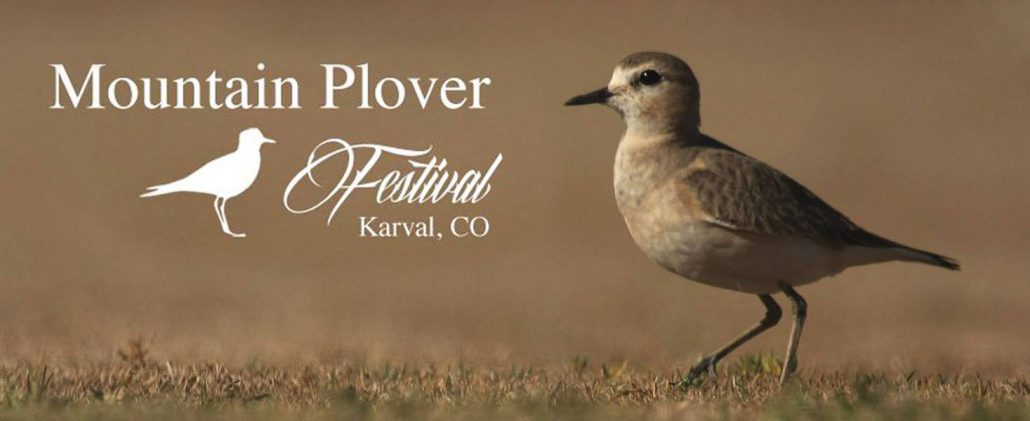
Nicknamed the “Prairie Ghost,” the Mountain Plover often turns its back to an observer
or a disturbance and stands motionless, a behavior that results in the virtual disappearance
of the drably marked bird. A terrestrial shorebird, the Mountain Plover breeds on
flat, bare ground in shortgrass prairies with sparse, short vegetation and agricultural
fields in the western Great Plains states of the U. S. Breeding birds are currently
known primarily from Colorado, Montana, and Wyoming, with more than 50% of the continental
population breeding on the eastern plains of Colorado. Nesting also occurs in small
areas of the Oklahoma and Texas panhandles, north central New Mexico, western Kansas,
and southwestern Nebraska. Most plovers winter in southern California, southern
Arizona, southwestern Texas, and northern Mexico.
Over the last 150 years, changes in land use, primarily the conversion of grassland
to cropland and commercial and urban development, along with transformation of the
grassland herbivore community from bison to domestic livestock have altered the
abundance and distribution of the Mountain Plover. The continental population has
declined by approximately 60% since 1966. The current population ranges from 11,000
– 14,000 individuals. The Mountain Plover was proposed for listing under the Federal
Endangered Species Act in 1999, but was withdrawn from consideration in 2003 because
threats to the species were not as significant as earlier believed and would not
likely endanger the species in the foreseeable future. Regardless, the general rarity
of the species and continued alterations of its habitat warrant its classification
as a species of high conservation concern. The Mountain Plover is recognized as
a species of special conservation concern in Colorado, Montana, Oklahoma, and California,
in need of conservation in Kansas, and a threatened species in Nebraska.
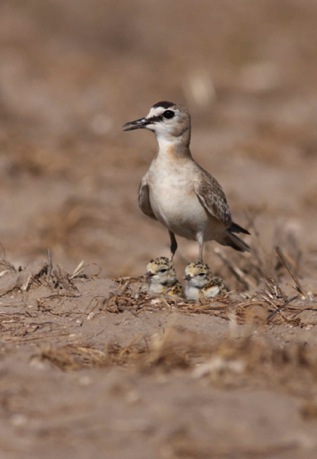
Mountain Plover chicks hatching in a nest located in a wheat
stubble field near Briggsdale, Colorado
Due to their dependence on bare ground for nesting, plovers are attracted to heavily
grazed shortgrass prairie, prairie dog towns, and cultivated land. Historically,
plovers occurred on nearly denuded prairie dog towns and in areas of major bison
concentrations. Currently, at least 30% of the Mountain Plover in Colorado and 90%
in Nebraska nest on cultivated land. Depending on the timing or farm implements
being used to work the fields, nests can be lost or damaged. More than 80% of the
breeding habitat in Colorado and Nebraska is privately owned and the majority of
landowners are farmers and/or ranchers. Thus, engaging private landowners and addressing
conservation on cultivated land is crucial for conserving Mountain Plover. Though
outreach efforts to landowners prior to 2003 revealed that many landowners were
familiar with the Mountain Plover, most were not aware that plovers nest on cultivated
fields. While landowners were willing to avoid plover nests while working their
fields, nests are difficult to see.
The Mountain Plover Nest Conservation in Cultivated Fields Project (Project) gave
landowners a system that helped identify and mark nests prior to working their fields.
The Project was implemented in 2003 through the cooperative effort of the Colorado
Division of Wildlife (CDOW), Nebraska Game and Parks Commission (NGPC), U. S. Geological
Service (USGS), and the U. S. Fish and Wildlife Service (USFWS). The Rocky Mountain
Bird Observatory (RMBO) was contracted by the CDOW to conduct the Project in Colorado
and by the NGPC in Nebraska. The Colorado Project was funded by the CDOW and the
Neotropical Migratory Bird Conservation Act administered by the USFWS. Funding for
Nebraska Project was provided by the NGPC and the Nebraska Environmental Trust.
The objectives of the Project were to heighten awareness for the Mountain Plover
by providing information on the species biology and conservation needs, and work
with private landowners through voluntary partnerships to minimize nest loss by
marking nests prior to cultivation activities.
To increase awareness of the Mountain Plover and secure landowner participation,
RMBO disseminated information through a variety of formats and venues to agricultural
agencies and organizations, media outlets, and individual landowners. Presentations
were made at landowner workshops and meetings of agricultural organizations. An
educational video/DVD provided landowners with information on Mountain Plover natural
history, tips on identification, and how they could participate. Most of the landowners
that we recruited to the Project came from a list of names provided by our agricultural
organization partners and other landowners participating in the Project. Many landowners
joined the Project following our presentations at workshops and meetings and after
visiting our information booths at county fairs and farm shows.
Mountain Plover incubating a marked nest
From 2003 through 2008, 200 landowners in Colorado and Nebraska participated in
the Project, enrolling more than 285,000 acres of farmland. Following a Mountain
Plover Nest Survey Protocol developed by RMBO, RMBO biologists surveyed cultivated
fields with suitable nesting habitat in mid to late April to determine presence
of Mountain Plover. A call-playback instrument was used to play a recording of a
Mountain Plover call in an effort to lure plovers closer to the observer so that
they could be seen and to illicit a vocal response. Fields occupied by plovers were
resurveyed prior to cultivation in May through mid June to locate and mark nests.
More than 470,000 acres were surveyed by slowly driving ATVs in a grid pattern,
stopping occasionally to look and listen for plovers. Seven hundred nests were located
and marked with two wooden lathes painted bright orange placed 6 feet from the nest
on either side. Landowners were provided a field map noting the location of each
nest. When possible, we returned to each nest after the field had been cultivated
or the expected hatch date to determine fate. Of the nests with known outcomes,
60%-80% were successful at producing at least one chick.
The Nest Conservation Project is a model of conservation agencies and organizations
working hand-in-hand with private landowners to address a conservation concern by
developing a program with conservation merit that fits the needs of agricultural
producers. It has shown how non-regulatory efforts can promote the conservation
of an at-risk species on private land. Because more landowners throughout the eastern
plains of Colorado and western Nebraska are now aware of this unique, shorebird
species and have shown a willingness to help conserve it, the Project is transitioning
to a landowner-led initiative. Nest marking is being phased out as landowners will
locate and avoid nests on their own during cultivation activities. A brochure titled
“Got Plover – We Need You,” a landowner guide to identifying and locating Mountain
plover and their nests, is being distributed to farmers and ranchers throughout
the breeding range in eastern Colorado. Information on breeding distribution, nesting
habitat, and how landowners can help conserve Mountain Plover on their land is included.
For more information contact:
Ross Lock
Mountain Plover Program Manager/Wildlife Biologist
ross.lock@rmbo.org. or (970) 482-1707 ext.23
|
|
|
|
|
|